What Fusaka hardfork means for Scroll
Oct 29, 2025 · 6 min read

What Fusaka hardfork means for Scroll
tl;dr
Fusaka, Ethereum's next hardfork, is now live on Sepolia and targets a December Mainnet launch. The upgrade requires no action from users or developers. It includes important opcode and precompile changes, set to reduce gas costs and improve Scroll's ZK proving system. While Fusaka also introduces a new blob fee floor, Scroll's commitment to maintaining low fees remains unchanged.
Fusaka is now live on the Ethereum Sepolia Testnet, targeting an Ethereum Mainnet launch by December this year. As an L2 that settles to Ethereum, what does this upcoming L1 hardfork mean for the Scroll ecosystem? How will Scroll adapt to these changes while preserving Ethereum compatibility? This article covers all the changes from the Fusaka hardfork and their direct relation to Scroll.
Do Users and Developers Need to Do Anything?
The short answer is no. Fusaka is a protocol change that requires only internal adjustments at protocol level that we will cover in this article. This means all existing wallets, dApps, nodes, and infrastructure pieces will continue to work as normal. The Fusaka Upgrade on Ethereum Sepolia did not affect Scroll Sepolia. Block production continued normally, requiring zero intervention from Scroll users, developers, or node operators. We anticipate the same uninterrupted performance for the Mainnet launch.
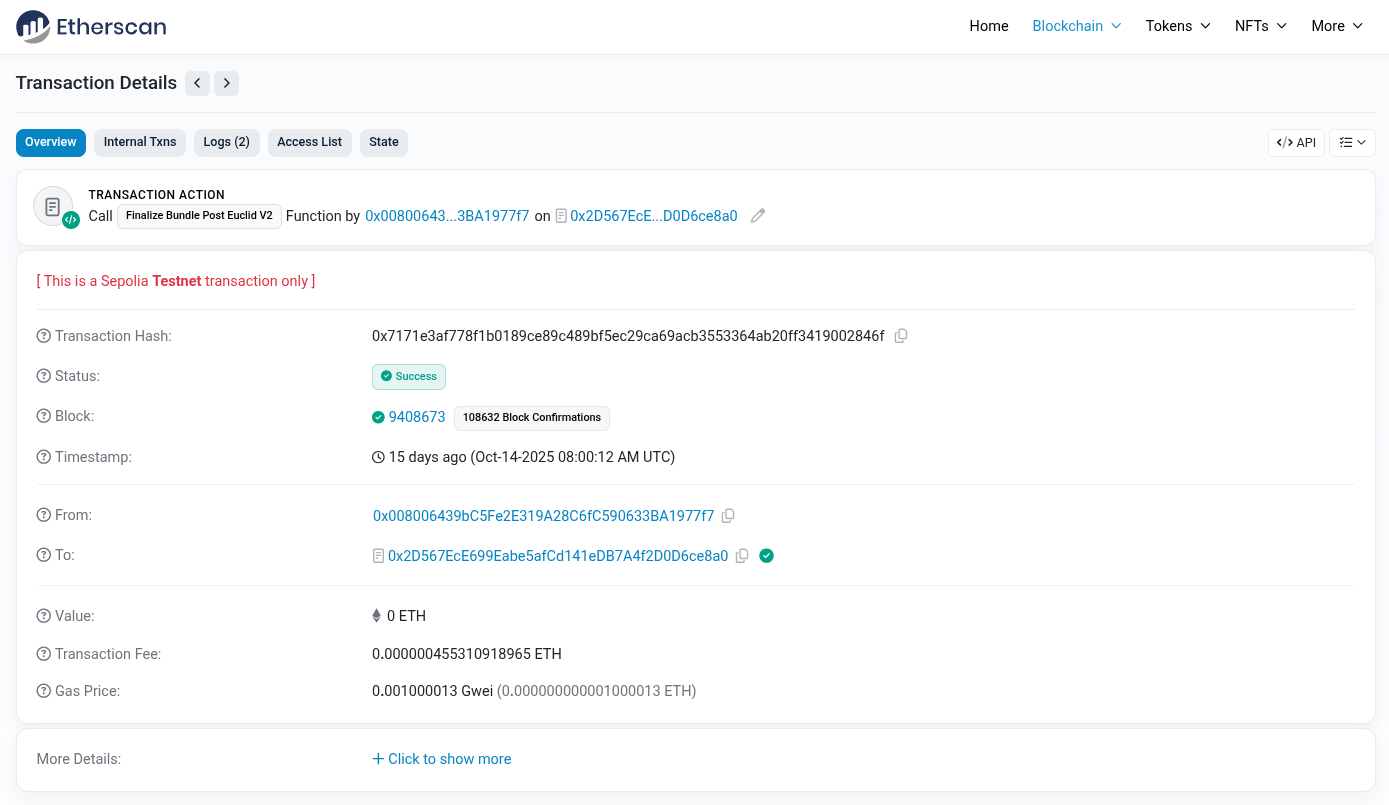 Scroll finalizing a bundle minutes after Sepolia Fusaka upgrade on October 14th as expected. We anticipate the same uninterrupted performance for the Mainnet launch.
While L1 and L2 hardforks happen separately, their timing is often synchronized to help L2s quickly utilize L1 improvements. Scroll addresses this by managing two stages of L1 preparation: mandatory protocol adjustments, which are already complete for Fusaka including the PeerDAS changes, and optional feature adoption. Scroll will roll out beneficial features, like the new CLZ opcode and precompile changes, as part of its Galileo hardfork expected by the end of this year, soon following the Fusaka upgrade.
Let’s now take a look at the upcoming changes and how they relate to Scroll.
Opcode & Precompile Changes
In this hardfork, Ethereum will include a new count leading zeros opcode, add a secp256r1 signature verification precompile, and make changes to the existing MODEXP precompile. Let’s take a closer look at what this means for Scroll.
-
EIP-7939 Count Leading Zeros
The Count Leading Zeros opcode, or
CLZ, simply counts the number of leading zero bits of a 32-byte in the EVM stack. While this might sound trivial, it can lead to significant gas cost and ZK proof proving optimizations. -
EIP-7951 Secp256r1 Verification
The other new addition is the secp256r1 signature verification precompile. It makes it poss.ible to sign and interact with wallets that support the most widely supported hardware authentication standards today (live on Android, iPhone, TEEs, and others). This EIP was already introduced by RIP-7212 in Scroll's Euclid upgrade. While the precompile gas costs changed, Ethereum's upgrade took special care in keeping the same functionality with the same interface as RIP-7212, which shows the strong synergy between L1 and L2 development.
-
EIP-7823 & EIP-7883
MODEXPChangesThese EIPs will set limits on
MODEXPand change its gas calculations. This opcode calculates the exponentiation of a number. This task is often called a prover killer because it imposes a significant computational requirements on ZK proving. By setting a cap, Scroll's prover will be able to have a better view of proving requirements, even in worst-case scenarios. Additionally, by adjusting the gas costs EIP-7883 intends to makeMODEXPmore aligned with proving cost.
Blobs & Gas Costs
One of the most anticipated changes in Fusaka is EIP-7594, PeerDAS. This change makes it so it’s no longer a requirement for all nodes to hold all Blob data at any time. This means that Ethereum will be able to provide more blobspace without significantly affecting L1 node requirements. In fact, the first blob count increase is already scheduled shortly after the Fusaka upgrade. For the time being, it won't affect Scroll users or node operators, it is an internal protocol detail. The Scroll sequencer will simply run what is called a supernode to hold all blob data needed for running full-fledged follower nodes that compare the L2 ledger to the data that was committed to L1. In preparation for Fusaka, Scroll already created a cloud snapshot of all Scroll Blobs which is the most efficient way to fetch them.
The biggest changes regarding gas costs will come from EIP-7918, where a cost floor will be imposed by Ethereum on blob costs. At first, it might seem that Scroll's gas costs will significantly increase, but we have to keep in mind now blob costs are a function of execution gas price and Fusaka also introduces EIP-7935 that reduce general gas costs. This means that even if a new floor price is set for blob costs, it may balance itself with generally lower Ethereum L1 gas costs.
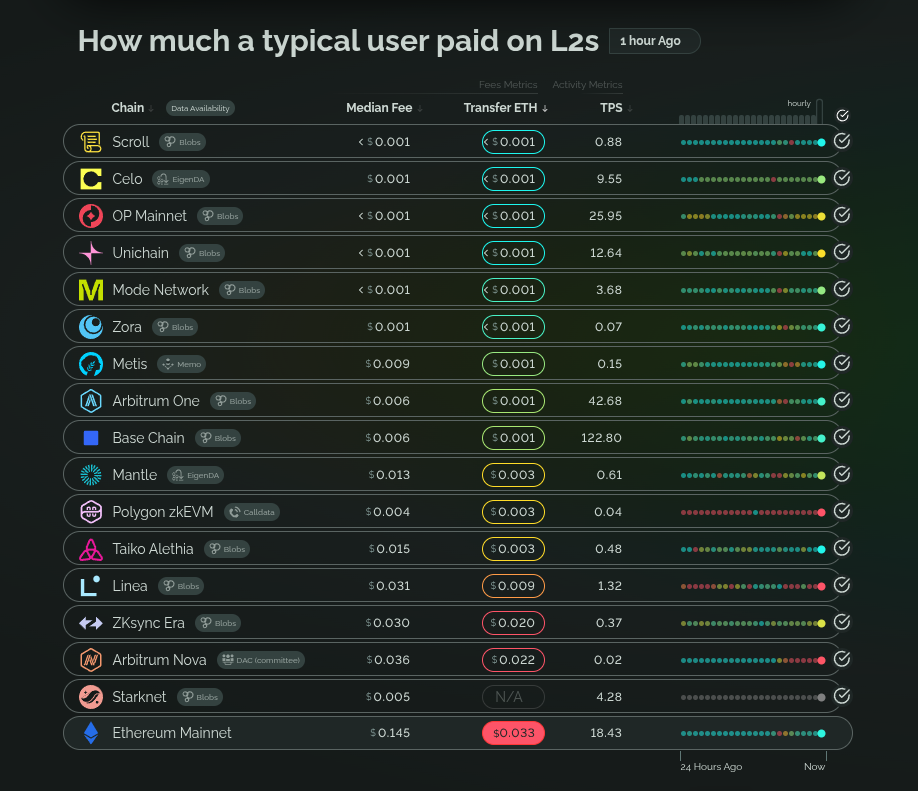 Today, Scroll is among the cheapest rollups. Users and developers can be assured that Scroll will maintain its commitment to keeping transaction fees low. Source: growthepie.com
Another very relevant Fusaka upgrade for Scroll is EIP-7892, which will introduce the possibility of BPOs (Blob Parameter Only Hardforks). This new type of hardfork allows L1 nodes to introduce changes related to blob fees faster, without needing to wait for a general hardfork. As noted by the EIP, blob fees are targeted to decrease over time as hardware capabilities and L2 blob consumption grow. With BPOs, Scroll will benefit from these L1 gas cost reductions much faster when that happens.
What Changes Don't Affect Scroll?
Not all changes will affect Scroll directly. EIP-7917 is a change to the consensus layer, where Scroll doesn’t participate. EIP-7642 and EIP-7910 are changes to RPC methods that also don’t affect Scroll directly. Scroll might still include these changes in the currently maintained l2geth and l2reth nodes to keep both L1 and L2 codebases as similar as possible.
Fusaka represents a significant step forward for Ethereum's scalability, and Scroll is prepared to integrate these changes. To learn more about Scroll's roadmap visit the blog and our technology page. If you're building on Scroll, check out our developer docs.